Friday, April 27, 2007

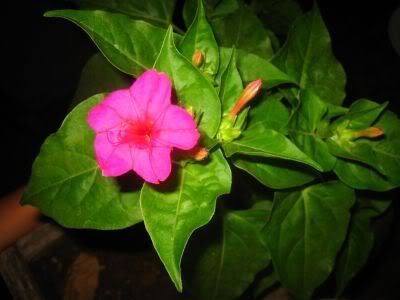
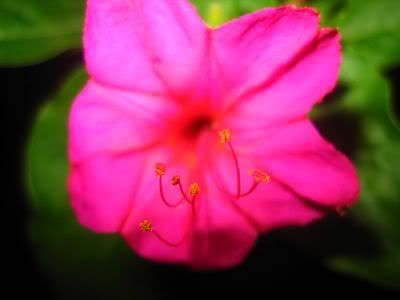
Four O'Clock (Mirabilis jalapa)

On July 1767, former US President Thomas Jefferson observed: "Mirabilis just opened, very clever."

He was pertaining to those plants which, several posts down, were proven to respond well to liquid fertilizer of human origin. The fragrant flowers of Four O'Clock suppsedly open up at approximately that time. Mine bloom at night though. Like this!:


This is something that every beginner, slacker, or busy gardener's dreams are made of. I took the seeds both from a beach garden in Anilao, and from a Merville sidewalk. They looked like little black pepper balls. I stuffed said seeds in pots with compost and watered them everyday, and within a week, ambitious little squirts came up. Within a month or two, they were a-blooming. And they bloom magnificently, beautifully, and in a super fragrant way, like sampaguita or something. Really really good stuff here! Minimum effort and maximum sensory return. They re-sow themselves too.

This plant has domineering roots, and is thus considered by a few anal persons to be invasive. They would surely win the common my-taproot-is-bigger-than-yours contests. So keep that in mind, and also remember that the whole plant is toxic to humans. Jesus always knows if you are plotting to place the seeds in your frenemy's pepper mill!

Saturday, April 21, 2007

Yellow Purslane


Just thought I'd share my related photo. I've got it hanging outside my window, and the plant has grown a lot in such a short span of time.

I got this from the bag of dried leaves I stole from Ayala Alabang. Someone tossed cuttings in. This is probably related to the local ulasiman that is medicinal, which bears yellow flowers. You can eat the leaves too.

Too early to tell if it's the same as Diane's moss rose! Or are they one and the same? I'm confused.

Tuesday, April 17, 2007

Rose Moss (Portulaca grandiflora)

Last week found me walking around U.P. (University of the Philippines) for the first time, and I was taken aback by the abundant and beautiful selection of flora in the campus. I found a gorgeous low-growing plant with a few flowers among it, which I wanted to grow. A nearby security guard was kind enough to give me some cuttings, without any flowers, to take home with me.

On the way home examining it, I found that its stems smelled so good! I almost wanted to take a bite out of them. I've run out of pots at home, and since I haven't exactly settled yet with my parents where exactly my territory lies in the garden, I planted them in the only available container left, a hanging pot.

Two days later, at around noon, I noticed that the bunch did have flowers. Well, it bloomed one! A beautiful shade of reddish pink petals with yellow stamens in the center. Later in the afternoon that same day, I was walking around the garden looking at my growing plants again (I do this like I sort of expect them to grow right before my eyes! I get sort of anxious waiting haha), I noticed that it the same flower had closed!

Apparently this herb-y smelling flower, is, a flowering herb. It's considered an herb because of its soft bodies and they do not develop woody tissues. And, I always wanted one of those flowers that close at certain times of the day, and without knowing it I even got me one! And what are the coincidences of planting them in the only pot left at home, a hanging pot, because it's one of the showier plants that are usually used for landscaping gardens (as borders, ground covers, etc...) and because they self-seed during warm climates and may be considered invasive, are perfect as hanging plants.

Originating from Brazil, the Rose Moss, also known as Vietnam Rose, closes in the afternoon and reopens in the morning. The photo below was taken at around 6:30 a.m.

It requires little maintenance to grow, especially in the Philippines, as they thrive in hot and dry conditions which would otherwise cause other flowers to wilt. Their fleshy stems store the moisture that allow them to bloom in these conditions. They need good drainage so growing them in sandy or loamy soils is a good choice, and allow the soil to dry in between waterings.
The entire plant may be used as a depurative, and the juice of the leaves can be applied to soothe snake and insect bites.

The flowers can come in single or double, and in a variety of colors.
The photo above was taken at around 11:30 am. Gorgeous, ain't it? :)
Tuesday, April 10, 2007

Oops, Did I Just Say Pee Is Good For Your Plants?

It's generally taboo, but many gardeners in the know secretly pee on their plants. For ethical purposes however, upstanding gardeners do not sprinkle on the leaves of edible herbs. Generally.

Now, I am not saying I feed my plants urine, or urinate on them. I have a career and a possible illlustrious future to safeguard.

I will, however, say that an unnamed person's pee has graced this yet-unidentified fat, healthy, and hydra-headed plant:


Compare its leaf growth and height to these three ones, which were planted even before it. I grew all of them from seed. The un-pissed on ones haven't even hydra-fied out at all! They are timid, though they get the same soil and sun:


Of course, the latter are three plants sharing one container, but I have investigated and found the single plant's roots have not creeped to the left-hand side of its receptacle. I have no side-view photos, but the lone one has grown way (like waaaay) taller! And it's even about to flower bright pink lovelies:


Feeding your plants urine requires polite discretion and one other consideration: dilute in water, as too much nitrogen is too much of a good thing, I'm afraid.

Saturday, April 7, 2007

Chuck It In Some Soil!

One night, when I was five years old, I was eating some cold lychees after dinner. As I watched everyone push the seeds to the sides of their plates, it hit me: I loved lychees, lychees came from trees, trees came from seeds... why not "make" my own lychees?

On a mission, I saved my seeds and buried a couple in the soil next morning, alongside my mom's ornamental hoo-haws. Sure enough, it first came up unimpressive and twerpy, but it had the beginnings of a lychee tree nonetheless. I practised the patience demanded by ungrafted fruit trees. Eventually, however, I moved out and of course, forgot about it.

The story would have ended sans epiphany if I had not, two years ago, happened to pass by my childhood home and notice a hulking, enormous lychee tree, several times larger than me! I could not believe that this beautiful massive thing was sitting there because of me, or rather, my sudden burst of curiosity and initiative on that fateful night.

Of course, someone else may reap the benefits, but who cares? Everyone should remember that all it takes is a little effort to collect the seeds you usually throw, bury them under soil (or even hurl them into empty lots), and wait patiently for them to bear fruit (or forget about them), and enjoy their shade and oxygen along the way. Fruits for you, me, or the guy who will move into your house in the future, it doesn't matter! We have to save all these aborted baby treetus-fetus things!

Many of the first human "orchards" were found in old latrine sites, where ancient communities would poop out seeds, which would then grow. Chucking seeds into soil, we are agents of propagation. Fruit and food trees do not belong in plantations. They belong to the people, and they should be free, whenever possible.

Fresh food is a right! Viva los salvadores de semillas!!! :D


Friday, April 6, 2007

A Must-Have Book

Growing up, I always saw this book in our den, alongside some rare, really old, and interesting books my parents had. I never took a second look at it, it never piqued my curiosity. It's even older than me! It was originally published in 1952, and my parents acquired it in May of 1974.

22 years later as I discovered my love and fondness for plants, especially flowers of all kinds, I've been so hungry for information. My dad directed me to this old book, his favorite plant book. Its pages are almost yellow, and its hard-bound cover rugged in the edges, which I think adds to its character.

I have to say it was quite "lucky" among the other books here at home because it was spared my vandals as a kid. I used to color on encyclopedia sets and my parents' other precious books!! :P

Philippine Ornamental Plants and Their Care by Dr. Mona Lisa Steiner is a must-have for plant lovers, amateur and professional gardeners alike.


It's more of a treasure chest for me than a book! It's complete with pictures (which greatly helped me in plant identification), information on propagation, soil types, there's even a part that tells you how to create hybrids! And, as the title says, Philippine ornamental plants... it's got everything (shrubs, poisonous plants, vines, ornamental trees, odd plants... you get the point:) here. Even if it was published decades ago, it provides timeless information.

It's considered a rare book, but you can purchase the used versions online (although a seller in Amazon's selling it for $75!). I have yet to check the local bookstores for brand new versions, which I'm not sure are available anymore.

If you're interested in buying it, there are other more affordable options you can check out, just click on the links below:

Tamarind Books

Ebay

AntiqBook

Happy reading :)

Thursday, April 5, 2007

Calamansi in the Limelight


In one of the last pages of this month's Elle Magazine, I chanced upon a little blurb on our national sour citrus of choice.

Apparently, it's come into some kind of popularity in the current cosmopolitan universe. Here's to your fifteen minutes of fame, calamansi!

Tuesday, April 3, 2007

Rafflesia- World's Largest Flower

Did you know that the world's largest flower:
  1. Is considered very rare and can be found in the Philippines?
  2. Has no roots, stems, or leaves?
  3. Has a foul, rotting smell?
  4. Can measure up to 100 cm in diameter and 11 kg in weight?
  5. Is a parasitic plant to a vine?
  6. Lacks chlorophyll, and is therefore incapable of photosynthesis?
  7. Has a lifespan ranging from 3-7 days?

Photo source: http://www.kirchersociety.org/blog/2006/03/

Friday, March 30, 2007

Trees of Interest

mental_floss magazine's blog outlines some favorite trees from round the world, including the Bodhi tree (pictured below), planted in 288 BC and moved from India to Sri Lanka in the 3rd century. Check it out!

Wednesday, March 28, 2007

Kadyos for Dinner

As a follow up to my kadyos post, here's a dish we recently had at home, with kadyos and camote (sweet potato) tops from the garden, tofu, and kinchay (Chinese celery):

Shooting Star (Clerodendrum quadriloculare)

This beauty of a tall shrub was one of the reasons why I started gardening just about a month ago. I never bothered about our home garden, until one day, I saw its cluster of flowers and realized how pretty and interesting they were. It stood out in the garden amongst all the shades of green because of its clusters of white flowers, each having a narrow pink tube.


I probably inherited the green genes from my dad. He's fond of plants and gardening, and apparently his sister gave him a cutting of this shrub to grow in our garden. Neither my dad nor my aunt had the right information on its name, but my dad was as curious as I was, and I was determined to find out.

My challenging pursuit to acquire knowledge of this plant, most especially its name, searching through the only clues I had - its physical properties, finally bore some fruit (no pun intended).

Belonging to the family Verbenaceae, the Clerodendrum is one of about 400 species of shrubs, lianas, and small trees that are said to have originated from the tropical regions of Africa and Asia. The Clerodendrum Quadriloculare, though, originated from the warm, sunny islands of our own beautiful Philippines. Its common names are Shooting Star and Philippine Glorybower.

It is a low maintenance plant (except for training), and thrives in warm climates. They require lots of sun and moist soil. The flowers are nectar-bearing so I am soon hoping to find colorful butterflies in the garden. The other day I spotted a bee hanging around one of the flower clusters. I've never been stung by one and hope my love for flowers now won't get me stings :P


Every morning now, I look forward to my garden visit as part of my newly-established ritual. Since my baby plants are still growing, I spend a few minutes checking each of my pots and then the Shooting Stars, of course. Between my mom and dad's plants, and now my own, I have to soon establish some sort of ownership in the garden! These are my dad's plants, really... But I always, always enjoy looking at the Shooting Stars. It's no wonder they are usually cultivated for ornamental purposes. It especially amuses me when they are still buds... And I mean literally buds! They remind me of cotton buds.


Look at their gorgeous leaves! They have rich green oval leaves which are dark purple underneath.

They propagate very easily because of its dense suckering habit. Because of this characteristic, the Clerodendrum Quadriloculare has been considered an invasive plant in some countries such as Palau, Pohnpei Islands in Micronesia, and some islands of Samoa. Thus it is advisable to keep them in pots. Severe pruning will result in outbursts of shoots and suckers. Right now our garden has 2 beautiful, tall- growing shrubs of these and are not causing any problems so far.

It is known as Ganalem to the Maranaos, the 6th largest Filipino ethnic group, who use this plant to treat boils and tuberculosis. Its methodology and other medicinal purposes are still unknown, forwarded information would be appreciated :)

Tuesday, March 27, 2007

Eggplant (Solanum melongena)


Though I don't usually eat it, I find the talong or eggplant to be thoroughly engaging and comical. The long shiny versions always reminded me of policemen's batutas in old Pinoy comedy sitcoms, or long cartoon noses. The short ones are just really cute, and, well... eggish (hence the name).

The area of origin of eggplant is debated (most say India), but it definitely found its way to Southeast Asia through China. As for the rest of the world, Arab and Persian traders took it to the Middle East and Mediterranean regions during the Middle Ages. The Moors probably then lugged it to Spain, from where it spread throughout Europe.

The pre-domesticated version was probably a spiny plant, with small bitter fruit (yes, it's one of those veggies which is really a fruit). It is, like the tomato, part of the largely poisonous nightshade family. No worries, though, the only sign of poison that eggplants exhibit is, as far as I know, the itchy tongue.

My adventure with eggplant had several futile beginnings throughout a few years, when I would take ready-looking seeds from particularly mature ones we were serving at home. I was never successful in growing them. So I took the easy way by buying three organic seedlings at the TESDA market one weekend. After a few months, it bore surprise fruit-- not the Filipino slender purple ones, but short green-and-white Thai ones! How adorable.


Being quite a dolt and unfamiliar with the non-purple varieties, I first waited for them to "ripen" into a wonderful yellow, only to find out that they were too tough to eat by then. The rest of my paltry yield was harvested appropriately, placed on the kitchen counter and probably mixed in some dish I didn't get to eat.

Start eggplants in a pot or in the ground, with compost-rich soil. Remember to cut your harvest instead of pulling, as it is quite difficult. Also they say that snipping eggplants before they are at their peak invites more fruiting. Get your little brothers to pee on your plant once in awhile for some nitrogen-- just at the base a.

About that overly mature yellow one, it didn't go to waste... Here are the seedlings I've just started up: